

Every fall brings the same rhythm: new backpacks, first-day-of-school photos, and a fresh round of expenses that seem to grow a little more each year. Whether it's packing lunches for a kindergartner, writing tuition checks for a college freshman, or somewhere in between, the cost of raising a child in the U.S. has reached a point that's reshaping how families budget, save, and plan, Hometap reports.
Raising a child through age 18 now costs $303,418 — the first time that figure has topped $300,000, and a jump of nearly 28% in just three years. And that's before a single college tuition bill arrives.
Below is a breakdown of what each stage of childhood costs right now, from daycare to college, including some of the extras that don't always make it into the budget.
Daycare and childcare: the early crunch
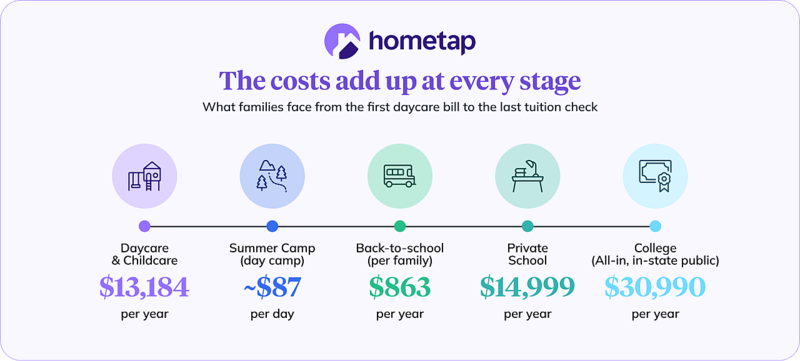
For many families, the financial reality of parenthood hits hardest before a child ever sets foot in a classroom. The national average price of childcare reached $13,184 a year in 2025.
That annual price tag makes up 10% of a two-parent household's median income and 33% of a single parent's. Infant care can run even higher, averaging roughly $14,760 a year at a daycare center.
Center-based infant care now costs more than in-state public college tuition in the majority of states. For families with two children in care, childcare for two exceeds median rent in every state with available data.
In one recent survey, the average parent reported spending 22% of their household income on childcare, and 20% reported going into debt to afford it.
Summer camp: the seasonal budget-buster
Just as school-year childcare bills pause, summer arrives with its own price tag. For working parents, summer camp often provides essential coverage for the months when school is out — and it's getting pricier.
Day camp averaged about $87 per day based on 2024 data, which adds up to more than $400 a week per child. Overnight camp roughly doubles that, at around $173 per day.
Multiplied across a few weeks of camp — and across more than one child — a season of camp can rival a mortgage payment.
Back-to-school and K-12 costs
Once the school year begins, spending shifts to supplies, clothes, and technology. Families with children in elementary through high school plan to spend an average of $863.86 on back-to-school shopping in 2026, pushing total K-12 back-to-school spending to a record $43.3 billion nationwide.
The typical family's budget breaks down roughly like this:
- Electronics: $293.11
- Clothing and accessories: $250.29
- Shoes: $174.01
- School supplies: $146.45
That's just the start-of-year haul — it doesn't account for the extracurriculars, field trips, sports fees, and mid-year replacements that come up over the following nine months.

Hometap
Private school tuition
For families who choose private education, the numbers climb steeply. The national average for private K-12 tuition sits at $14,999 a year, with elementary schools averaging around $14,018 and high schools closer to $17,954.
Costs vary widely by region and school type — tuition in the most expensive states can run well over $28,000 a year, and elite independent or boarding schools reach far higher. For a family with more than one child in private school, tuition alone can rival a second mortgage.
The college years: tuition, housing, and beyond
If the early years are defined by childcare and the middle years by supplies and activities, the teen years bring one of the largest expenses most families will face for a child: college.
For the 2025-26 school year, average published tuition and fees came in at:
- Public four-year, in-state: $11,950
- Public four-year, out-of-state: $31,880
- Private nonprofit four-year: $45,000
Tuition is only part of the cost. Once housing, food, books, and other essentials are factored in, the total estimated cost of attendance jumps to roughly $30,990 a year for in-state public students and $65,470 a year at private nonprofit colleges.
A few additional school costs often catch families off guard:
- Housing and food. Room and board average about $14,034 a year at public four-year schools, and those costs have been rising faster than tuition itself. Over four years, housing and food alone can total more than $54,760.
- Books and supplies. Course materials and textbooks add $1,000 on average — before the laptop or computer most first-year students buy.
- Technology. First-year students spend around $800 a year on technology, with the majority purchasing a computer for school.
Stretched across four years — and across multiple kids — college can easily become the largest line item in a family's budget.
The full picture: what it all adds up to
Hometap
The costs of raising a child don't arrive all at once; they compound over two decades or more. Daycare gives way to camp and school supplies, which give way to activities and possibly private tuition, which give way to college. Through all of it, the total cost of raising a child keeps climbing — up nearly 28% in just three years.
For many families, these aren't discretionary expenses they can simply cut; they're the fundamentals required to set kids up for success — which is prompting more households to look for ways to manage rising costs.
Home equity as a resource some families are considering
U.S. homeowners currently hold a near-record $34.9 trillion in home equity. For many individual homeowners, that translates into hundreds of thousands of dollars of value built up in a home — value that's real, but not easily converted into cash for a childcare bill or tuition payment.
Rising costs are a widely reported source of financial pressure for homeowners. A survey of 1,000 U.S. homeowners found that a majority reported feeling moderately to extremely financially stressed, with rising homeownership costs cited as a top concern. Separately, mortgage rate lock-in has become a factor in homeowners' decisions to stay put: more than half of homeowners surveyed said there's no mortgage rate that would make them comfortable selling this year, according to Bankrate.
Selling isn't the only way to access home equity. Homeowners who don't want to sell or take on a new monthly payment have a few options, including home equity loans, HELOCs, cash-out refinances, and a newer category of product known as a home equity investment (sometimes called a home equity agreement). With a home equity investment, a homeowner receives a lump sum of cash in exchange for a share of the home's future value, without monthly payments; the arrangement is settled — through refinancing, a loan, savings, or a home sale — within a set term, often up to 10 years.
As with any financing option, a home equity investment carries costs and trade-offs, and it isn't the right fit for every homeowner. Families weighing whether to tap their equity to cover childcare, tuition, or other rising costs typically compare these options against a home equity loan or HELOC and consult a financial, tax, or legal professional to determine what best fits their situation.
This story was produced by Hometap and reviewed and distributed by Stacker.